
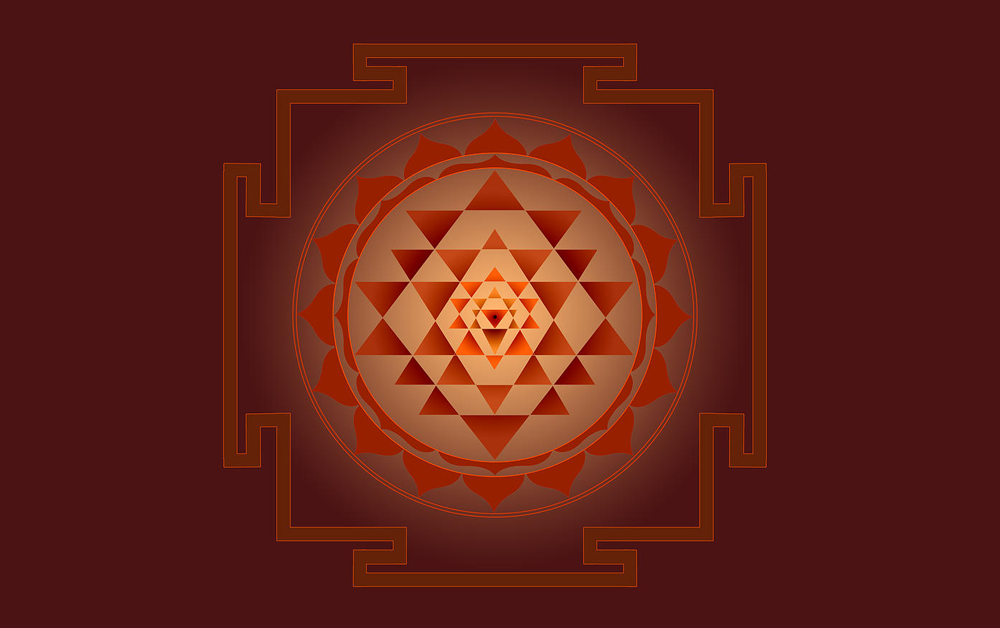
The opening names of Lalita Sahasranama provide a key to the whole hymn. The Divine Mother is first approached as Sri Mata, the auspicious Mother, but the sequence soon reveals her as sovereign, consciousness, sacred form, mantra, and the indwelling center of worship. Part two of this introduction examines how the thousand names connect visible imagery with Sri Chakra and inward contemplation.
Sri Mata: the Divine as Mother
The hymn begins with Sri Mata. On the devotional level, the name establishes an immediate relationship: the source of the universe is not remote, but accessible as Mother. Philosophically, the name points to that from which beings arise, by which they are sustained, and into which they return. The tenderness of the maternal image and the metaphysical idea of an ultimate source are held together in one name.
The next names expand this vision. Sri Maharajni presents her as the supreme queen, and Srimat Simhasaneshvari as the sovereign seated upon the throne. Her motherhood is therefore not a sign of limitation. She is both intimate and independent, the compassionate presence approached by the devotee and the ruling power through which the cosmos functions.
Chidagni-kunda-sambhuta: arising from the fire of consciousness
The fourth name, Chidagni-kunda-sambhuta, describes Lalita as arising from the altar of the fire of consciousness. It shifts the reader from a royal image to the hymn's deepest philosophical ground. The Mother is not merely one being within the universe. She is chit, consciousness itself, represented as a living fire from which manifestation appears.
This movement from form to consciousness recurs throughout the Sahasranama. Names describing the Mother's eyes, smile, ornaments, feet, and radiance support loving visualization. Other names deny every limiting attribute and identify her with the formless absolute. The two perspectives are not presented as enemies. Form offers the mind a sacred focus; formless awareness discloses the reality to which the form points.
The three dimensions of the Mother
The source text explains the Mother through three dimensions. Her gross or manifest form can be visualized and worshipped. Her subtle form is mantra, sacred sound, and the ordered power expressed through syllables. Her supreme form is pure consciousness beyond conceptual limitation. Lalita Sahasranama moves repeatedly among these dimensions, allowing devotion, mantra, and knowledge to illuminate one another.
This is why the hymn can be meaningful even before its technical references are fully understood. A name can function as praise, as an object of meditation, and as a compact statement of theology. Over time, its apparent meaning and contemplative depth begin to converge.
Sri Chakra as palace and map
Several names describe the Mother's divine city and residence: Srinagara, the wish-fulfilling Chintamani house, the Kadamba grove, and the great lotus forest. In outward worship these images are associated with Sri Chakra, the sacred geometric form whose enclosures lead toward the central bindu, the seat of the Goddess.
The same landscape can be contemplated inwardly. The palace is not only in a distant divine realm; it can be understood as the sanctified body and mind of the practitioner. The journey through the enclosures then becomes a movement from scattered attention toward the silent center. Outer ritual provides a precise sacred language, while inner worship turns that language into disciplined awareness.
Formal Navavarana worship has detailed requirements and belongs within proper instruction. A general reader need not imitate its ritual details to appreciate its central insight: spiritual life gathers the many forces of experience and returns them to a single conscious source.
The implements as symbols of inner life
The early names portray Lalita holding a noose, a goad, a sugarcane bow, and five flower arrows. These implements can be seen as divine ornaments, but the tradition also reads them psychologically.
- The noose is associated with attraction, attachment, and the bonds created by habitual likes and dislikes.
- The goad represents the directing power that turns awareness away from distraction and toward its goal.
- The sugarcane bow represents the mind, sweet and powerful but difficult to keep steady.
- The five arrows correspond to the subtle qualities behind sound, touch, form, taste, and smell, through which the sensory world captures attention.
Contemplating these symbols changes the imagery from mythology into self-observation. The question is no longer only, "What does the Goddess hold?" It becomes, "What binds my attention, what directs it, and who is aware of the mind and senses?"
External worship and internal worship
The source contrasts external ritual with Samayachara, an inward mode of worship based on bhavana, or sustained sacred imagination. Offerings of water, fragrance, flame, and food can be visualized mentally. The surrounding deities are contemplated as powers of consciousness, and the practitioner gradually sees the worshipper, the act of worship, and the one worshipped as expressions of a single reality.
This does not make outward worship inferior. Physical ritual can educate attention through posture, sound, fragrance, gesture, and offering. Inner worship draws those same actions into the mind. The essential movement in both is from self-centered activity to consecrated awareness.
Sacred sound and the need for guidance
Lalita Sahasranama contains many references to letters, seed syllables, and Sri Vidya mantras. The Mother is praised as Matrika-varna-rupini, the form of the fundamental sounds, and as Sri Vidya, sacred knowledge embodied as mantra. In this understanding, sound is not merely a label attached to reality; disciplined sacred speech is itself a mode of divine presence.
Technical mantra combinations, nyasa, and initiated Sri Vidya practice should be learned within a qualified lineage. A beginner can still work fruitfully with the stotra by listening, reciting carefully, studying meanings, and meditating on accessible names such as Sri Mata, Dayamurti, or Shubhakari.
A simple contemplative practice
- Sit quietly and let the breath settle without forcing it.
- Bring the name Sri Mata to mind and reflect on the Divine as the source and support of life.
- Visualize a gentle light in the heart or simply remain aware of the sense of presence.
- Notice attractions, aversions, and sensory distractions without following them.
- Conclude with gratitude rather than seeking an unusual experience.
This is not a substitute for initiated Sri Vidya practice. It is a devotional reflection grounded in the hymn's accessible themes. Part three will follow the names into the chakras, the states of consciousness, and the non-dual teaching that culminates in liberation.
Explore the full series
Primary reference: Sri Lalita Sahasranama Stotram - An Insight by Swami Shantananda Puri.