When we think about geometry, we often imagine classrooms filled with diagrams, formulas, rulers, and compasses. But thousands of years ago, geometry was not simply a school subject. It was a practical skill used to solve real-world problems.
In ancient India, one of the earliest collections of geometrical knowledge appeared in texts known as the Sulba Sutras. These works explain how to measure land, draw accurate shapes, and construct ritual fire altars using ropes and simple tools.
The Sulba Sutras show us how mathematical ideas can grow from practical needs.
What Does “Sulba Sutra” Mean?
The word Sulba, sometimes written as Shulba or Śulba, refers to a cord, rope, or measuring string.
The word Sutra means a short rule, instruction, or formula.
Therefore, Sulba Sutra can roughly be understood as:
“Rules of measurement using a cord.”
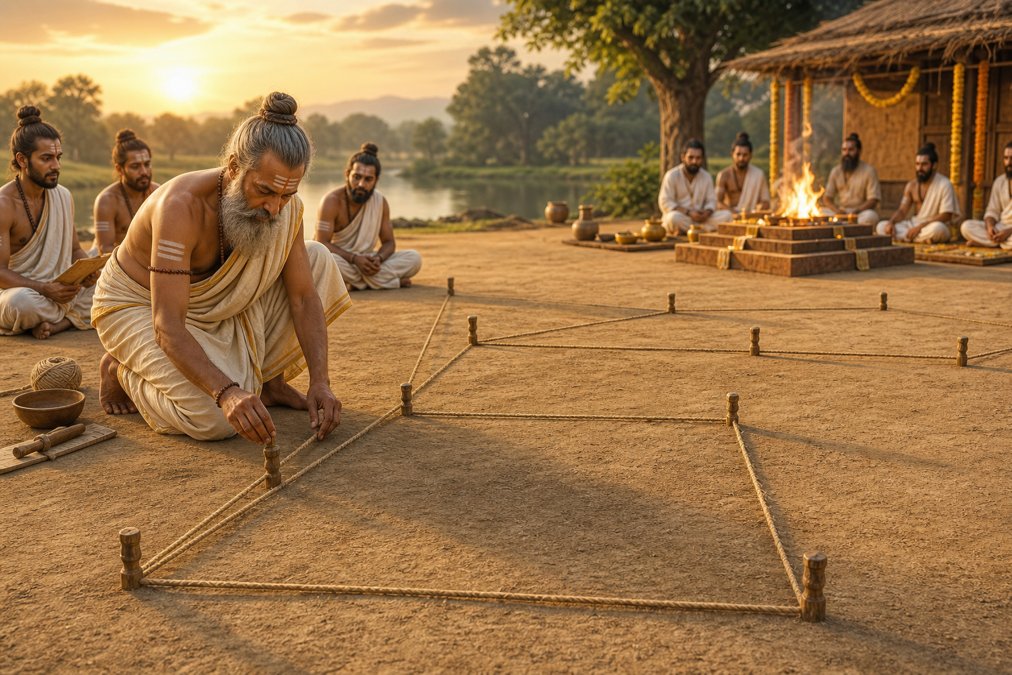
This name describes the method used by ancient builders. Instead of modern measuring tapes, rulers, or surveying equipment, they used ropes to mark distances, draw straight lines, create circles, and construct right angles.
A rope could be stretched between two points to form a straight line. By fixing one end and rotating the other, it could be used to draw a circle. Knots placed at measured intervals helped builders create accurate shapes.
Why Were the Sulba Sutras Written?
The Sulba Sutras were mainly connected with the construction of Vedic fire altars, known as yajna kundas or vedis.
In Vedic rituals, fire altars had to be built according to specific measurements and shapes. Some were square, while others were shaped like circles, birds, chariots, tortoises, or other symbolic forms.
These altars could not be built approximately. Their dimensions, orientation, shape, and area had to follow prescribed rules.
This created several practical questions:
- How can a perfect square be constructed?
- How can a right angle be created?
- How can a square be changed into a rectangle?
- How can a circular area be converted into a square of nearly equal area?
- How can the size of an altar be increased without changing its shape?
- How can different sections be fitted together accurately?
To answer such questions, ancient ritual specialists developed geometrical methods. These methods were recorded in the Sulba Sutras.
The mathematics in these texts was therefore not created as an abstract classroom exercise. It developed as a tool for accurate construction.
Who Wrote the Sulba Sutras?
The Sulba Sutras are not a single book written by one person. They are a group of texts associated with different Vedic traditions.
The best-known Sulba Sutras are attributed to:
- Baudhayana
- Apastamba
- Manava
- Katyayana
Among them, the Baudhayana Sulba Sutra and the Apastamba Sulba Sutra are especially well known for their mathematical content.
These texts belong broadly to the first millennium BCE. Exact dates are difficult to establish because ancient Indian knowledge was often preserved orally before being written down.
The word “author” should also be understood carefully. These sages may have compiled, organised, taught, or transmitted knowledge that had developed over generations.
Geometry with Ropes
One of the most fascinating features of the Sulba Sutras is their simplicity.
The builders did not have laser levels, digital measuring devices, or printed graph paper. Their main tools were:
- Ropes
- Wooden pegs
- Measuring rods
- Marked distances
- Careful observation
Using these simple tools, they could produce surprisingly accurate geometrical constructions.
For example, imagine fixing two pegs in the ground and stretching a rope between them. This gives a straight reference line.
A rope tied to a central peg can be rotated to mark a circle.
A rope divided into suitable lengths can help form a triangle with a right angle.
These techniques are similar in spirit to the methods still used in basic land surveying and construction.
The Rule Associated with the Pythagorean Theorem
One of the most discussed passages in the Sulba Sutras describes the geometrical relationship that is now commonly called the Pythagorean theorem.
In simple terms, the theorem states that in a right-angled triangle:
The square of the longest side equals the sum of the squares of the other two sides.
Today, this is written as:
a² + b² = c²
The Baudhayana Sulba Sutra expresses this relationship in practical geometrical language. It explains that the diagonal of a rectangle produces an area equal to the areas produced separately by its length and width.
This does not mean that the Sulba Sutras presented the theorem in the same style as a modern mathematics textbook. Their purpose was construction, not formal mathematical proof in the later Greek tradition.
It is also important to avoid turning the history of mathematics into a competition between civilisations. Knowledge related to right-angled triangles was known in different ancient cultures, including India and Mesopotamia.
The importance of the Sulba Sutras lies in showing how clearly such geometrical knowledge was understood and applied in ancient India.
Understanding the Square Root of Two
Another important mathematical idea found in the Sulba tradition is an approximation of the square root of two.
Why was this number important?
Suppose a square has sides of one unit each. The diagonal running from one corner to the opposite corner has a length equal to the square root of two.
This diagonal becomes useful when constructing a square with twice the area of the original square.
The Apastamba Sulba Sutra gives a remarkably accurate method for approximating this value. The method is expressed through a verbal rule rather than a decimal number.
This shows that the scholars involved were not only drawing shapes. They were also working with numerical relationships required for precise construction.
Changing One Shape into Another
The Sulba Sutras contain methods for transforming geometrical shapes while preserving approximately the same area.
For example, they discuss procedures for:
- Turning a rectangle into a square
- Combining two squares into a larger square
- Dividing a square into smaller sections
- Constructing a square equal in area to a given circle
- Constructing a circle approximately equal in area to a square
These problems appeared because ritual instructions sometimes required an altar to change shape while keeping the same total area.
Imagine that an altar built as a square had to be rebuilt in a circular form without changing its ritual area. The builders needed a reliable geometrical method to achieve this.
Some of these conversions were exact. Others were practical approximations.
This distinction is important. The Sulba authors were solving construction problems with the tools available to them. Their methods were designed to work on the ground, not merely on paper.
Mathematics Hidden Inside Ritual
At first glance, ritual and mathematics may seem like completely different subjects.
However, in many ancient societies, scientific knowledge developed through practical activities such as:
- Building
- Agriculture
- Astronomy
- Navigation
- Trade
- Calendar calculation
- Religious ceremonies
In the case of the Sulba Sutras, ritual altar construction encouraged the development and preservation of geometry.
The ritual setting gave mathematical knowledge a purpose. It required measurements to be repeated accurately and passed from teacher to student.
This is one reason the Sulba Sutras are historically significant. They show that mathematics can emerge from cultural, spiritual, and practical needs at the same time.
Why Were the Rules Written So Briefly?
The Sulba Sutras are written in a compact style.
A sutra is usually short and designed to be memorised. It may contain only the essential rule, leaving the detailed explanation to a teacher.
This was suitable for an oral teaching tradition. Students were expected to learn directly from experienced instructors who could demonstrate the construction physically.
Because of this, reading a Sulba Sutra today can be difficult. A short sentence may describe a complete geometrical procedure, but the intermediate steps may not be stated.
Modern scholars must study the language, commentaries, ritual context, and possible physical constructions to understand the full meaning.
Were the Sulba Sutras Mathematics Textbooks?
Not in the modern sense.
They do not begin with definitions, followed by examples, exercises, and formal proofs. They are primarily manuals of ritual construction containing mathematical rules.
However, this does not reduce their mathematical value.
A carpenter may understand geometry without writing a textbook about it. A surveyor may apply trigonometric ideas without discussing mathematical philosophy. In the same way, the authors of the Sulba Sutras preserved geometry through instructions for practical work.
The texts reveal mathematical thinking through what they ask builders to do.
Why Are the Sulba Sutras Important Today?
The Sulba Sutras are important for several reasons.
First, they provide evidence of an early and sophisticated tradition of practical geometry in India.
Second, they show that mathematics was deeply connected with daily practice, craftsmanship, ritual, and observation.
Third, they help us understand the development of Indian mathematical thought before the later achievements associated with astronomy, algebra, arithmetic, and the decimal place-value system.
Fourth, they remind us that mathematical knowledge has developed in many civilisations. The history of mathematics is not the story of a single country or individual. It is a long human journey shaped by different cultures and practical needs.
Avoiding Exaggerated Claims
The Sulba Sutras deserve appreciation without exaggeration.
It is reasonable to say that they contain early geometrical rules, sophisticated constructions, an understanding of right-triangle relationships, and accurate numerical approximations.
However, it is better to avoid claims that they contain every part of modern mathematics or that all later geometry came directly from them.
Ancient texts should be understood within their own purpose and historical setting.
Their true achievement is already remarkable: using ropes, pegs, observation, and carefully remembered rules, ancient Indian scholars developed a powerful system of practical geometry.
A Simple Modern Comparison
A useful way to understand the Sulba Sutras is to compare them with a construction manual.
Suppose a modern engineer writes instructions explaining:
- Measure a certain distance.
- Mark two fixed points.
- Stretch a line between them.
- Use another measured line to form a right angle.
- Draw a square of a required area.
- Divide or enlarge it according to a given rule.
The Sulba Sutras operate in a similar manner, although their instructions are expressed in the compact language of the ancient sutra tradition.
They are practical guides supported by mathematical knowledge.
Conclusion
The Sulba Sutras offer a fascinating window into the scientific thinking of ancient India.
They began with a practical challenge: constructing Vedic fire altars accurately. To solve that challenge, ancient scholars developed methods for measurement, right angles, diagonals, squares, circles, area transformations, and numerical approximation.
Their work demonstrates an important truth about the history of knowledge. Mathematics does not always begin with symbols written on a blackboard. Sometimes it begins with a rope stretched across the earth, a peg fixed into the ground, and a human need to build something with precision.
The Sulba Sutras are therefore more than old ritual manuals. They are records of observation, reasoning, craftsmanship, and the early human effort to understand space through measurement.