
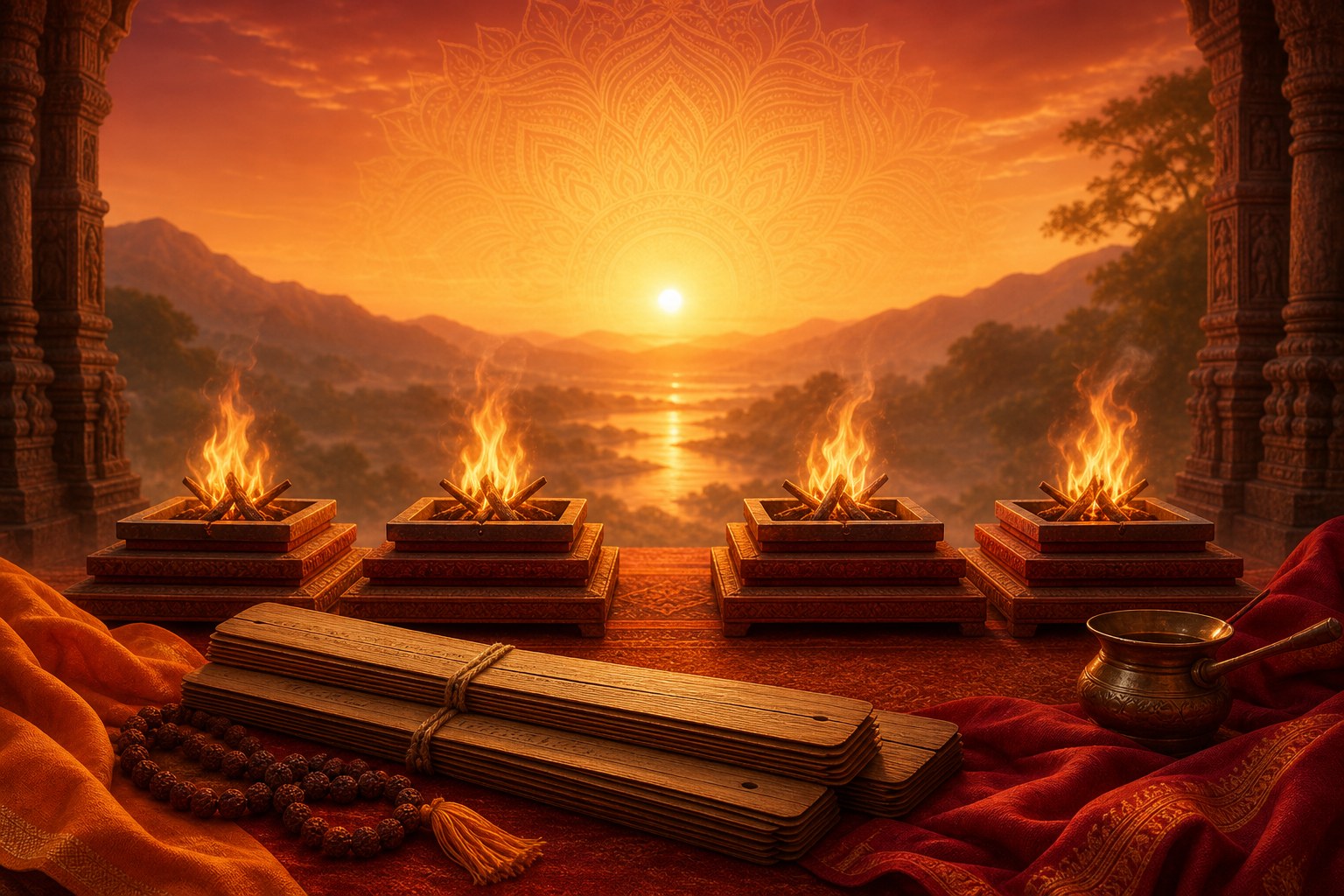
The Vedas are the oldest and most authoritative scriptures of Hindu tradition. Classified as Shruti—that which is heard or revealed—they are regarded not as human compositions but as eternal wisdom disclosed to ancient rishis (seers) in deep meditation. For millennia, the Vedas have shaped ritual, philosophy, language, and the spiritual life of the Indian subcontinent.
What Are the Four Vedas?
Tradition recognizes four principal Vedas, each with a distinct emphasis:
- Rigveda — The earliest collection, composed largely of hymns praising deities such as Agni, Indra, and Surya, and reflecting early Vedic cosmology and sacrifice.
- Samaveda — Drawn mainly from Rigvedic verses, arranged for melodic chanting (samagana) during ritual.
- Yajurveda — Prose and verse formulas (mantras) recited by priests during yajna (fire sacrifice), in Shukla (white) and Krishna (black) recensions.
- Atharvaveda — Hymns, charms, and healing formulas addressing daily life, protection, and philosophical reflection alongside ritual.
Structure: Samhitas, Brahmanas, Aranyakas, and Upanishads
Each Veda is traditionally organized in layers. The Samhita is the core collection of mantras. The Brahmanas explain ritual procedure and theological meaning. The Aranyakas (forest texts) bridge outward ritual and inward contemplation. The Upanishads, often appended to these layers, carry the Vedas into profound inquiry on Brahman, Atman, and liberation—topics explored further in our Upanishads section.
Oral Transmission and Preservation
For centuries before widespread writing, the Vedas were preserved through rigorous oral tradition (shruti-patha). Multiple recitation methods—patha systems such as ghana and krama—were designed to detect even a single syllable error. This discipline protected textual integrity across generations and remains a living practice in Vedic schools (pathashalas) today.
Why the Vedas Matter Today
The Vedas are not merely historical documents. They inform temple worship, mantra science, astrology (Jyotisha), architecture (Vastu), and the philosophical foundations of yoga and Vedanta. Whether one approaches them as devotion, scholarship, or spiritual practice, the Vedas open a doorway into the worldview from which later scriptures—including the Bhagavad Gita and the Puranas—draw their authority and imagery.
How to Begin Studying the Vedas
Start with reliable translations and commentaries, ideally with guidance from a qualified teacher. Read introductory hymns from the Rigveda, notice how ritual and cosmology intertwine, and follow themes—fire, speech (vak), order (rita)—into the Brahmanas and Upanishads. On Vedic Matters, this category gathers articles that make the Vedic corpus accessible without losing respect for its depth and living tradition.