
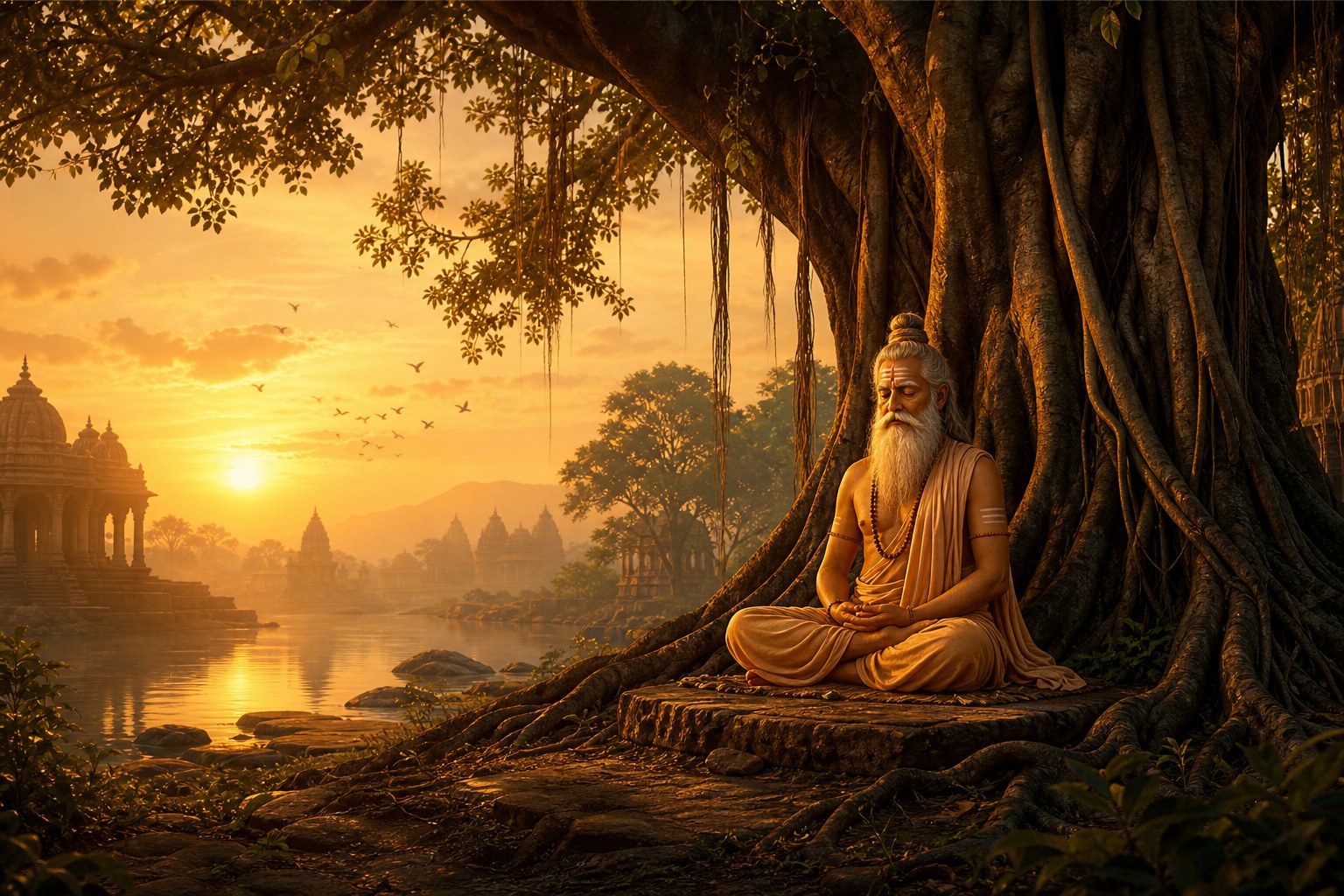
The Upanishads are among the most influential philosophical texts in human history. Appended to the Vedic corpus yet distinctive in spirit, they shift attention from outward ritual toward inward inquiry: What is the ground of existence? Who am I beyond body and mind? How may one attain lasting freedom (moksha)?
Meaning of “Upanishad”
The word Upanishad is often explained as “sitting down near”—the intimate transmission of truth from teacher to student. Another traditional derivation links it to the destruction of ignorance. Either way, the Upanishads record dialogues between sages such as Yajnavalkya, Uddalaka Aruni, and Gargi, and seekers who press for answers beyond ritual formulae.
Principal Themes
Although each Upanishad has its own style, several themes recur throughout the corpus:
- Brahman — The ultimate, all-pervading reality underlying the cosmos.
- Atman — The innermost Self, not identical with ego or personality.
- Tat tvam asi — “Thou art That”: the essential non-duality of Atman and Brahman in the Chandogya Upanishad.
- Moksha — Liberation from the cycle of birth and death through knowledge (jnana), discipline, and meditation.
Major Upanishads
Tradition lists many Upanishads; ten to thirteen are especially prominent for study and commentary. The Isha, Kena, Katha, Prashna, Mundaka, Mandukya, Taittiriya, Aitareya, Chandogya, and Brihadaranyaka form the core set commented upon by Shankaracharya and later Vedanta masters. The brief Mandukya, with its exposition of Om and the four states of consciousness, is often regarded as a complete philosophical summary.
Upanishads and the Schools of Vedanta
Later Vedanta schools—Advaita (non-dual), Vishishtadvaita (qualified non-dual), and Dvaita (dual)—all root their systems in Upanishadic passages, interpreted through the Brahma Sutras and the Bhagavad Gita, together called the Prasthana Trayi (threefold foundation). Understanding the Upanishads is therefore essential for anyone studying Hindu philosophy in depth.
Approaching the Texts Today
Read slowly, preferably with a trusted translation and commentary. Pay attention to parables—the chariot in the Katha Upanishad, the salt in water in the Chandogya—that convey subtle truths through story. Complement study with ethical living and meditation; the Upanishads themselves insist that Self-knowledge ripens in a prepared mind. This category on Vedic Matters will guide readers through individual Upanishads, key verses, and their relevance to modern spiritual life.