
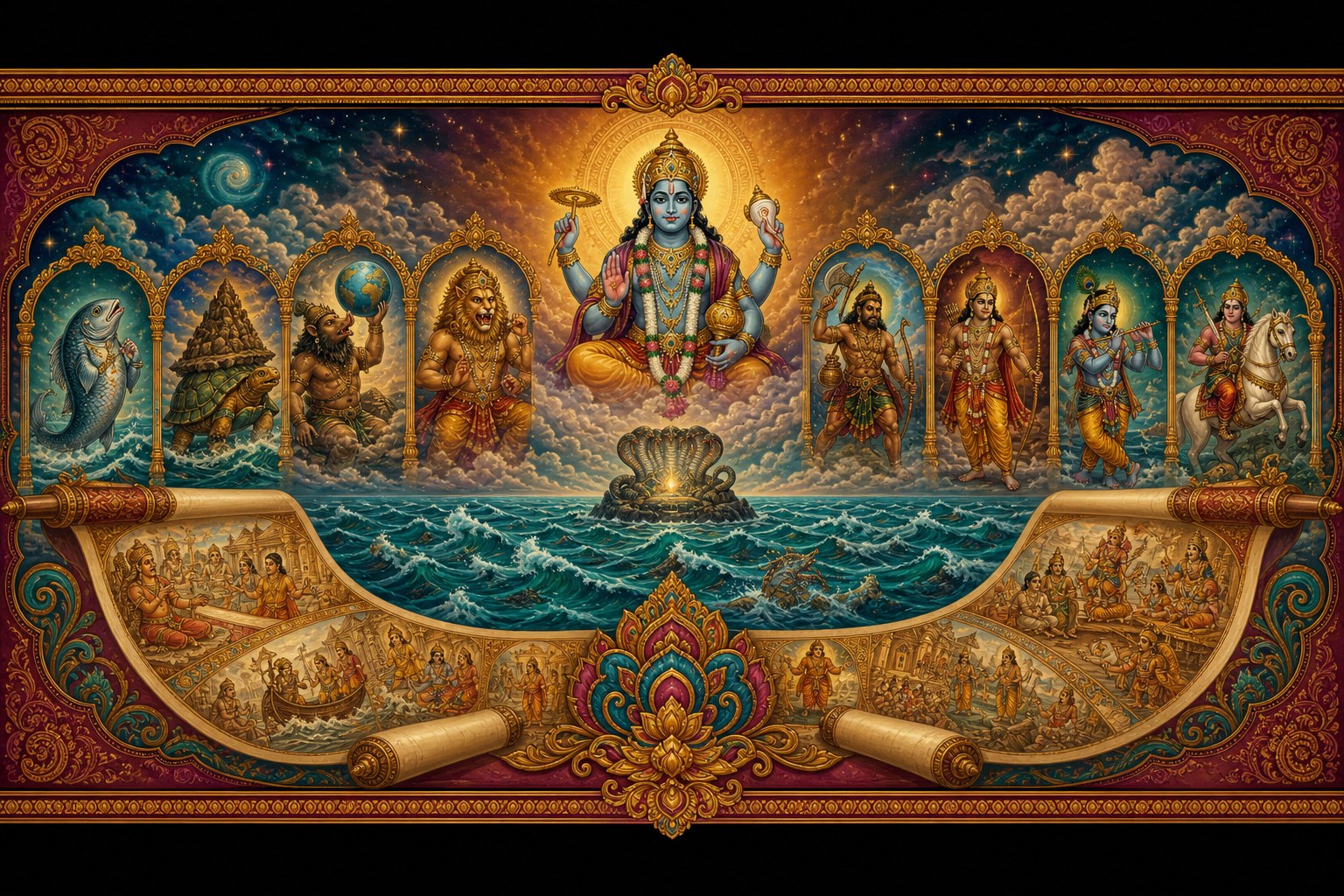
The Puranas are a vast library of Sanskrit literature that has shaped Hindu worship, art, festival culture, and moral imagination for centuries. Classified as Smriti—remembered tradition—they complement the Vedas and Upanishads by narrating cosmology, genealogy, geography, and the lilas (divine play) of gods and goddesses in language accessible to all.
What Is a Purana?
Traditional definition lists five characteristics (pancha-lakshana): primary creation (sarga), secondary creation (pratisarga), genealogies (vamsha), ages of Manu (manvantara), and royal lineages (vamshanucharita). In practice, Puranas range far beyond this schema, incorporating theology, pilgrimage guides (mahatmya), ritual instruction, and popular narrative.
Major Puranas and Their Focus
Eighteen Maha Puranas are traditionally listed, often grouped by primary deity:
- Vaishnava — Vishnu, Bhagavata, Garuda, Padma, Narada, Varaha, Matsya, Kurma, Brahmanda
- Shaiva — Shiva, Linga, Skanda, Agni, Vayu
- Shakta — Markandeya, Devi-Bhagavata
- Brahma — Brahma Purana (and overlapping cosmological themes elsewhere)
The Bhagavata Purana, with its accounts of Krishna's childhood and teachings, and the Shiva Purana and Devi Mahatmya (within the Markandeya tradition) remain among the most widely read.
Puranas and the Epics
The Puranas interconnect with the two great epics—the Ramayana and Mahabharata—which are sometimes called Itihasa (thus it happened). Stories cross-reference: avatars of Vishnu, the churning of the ocean, the descent of the Ganga, and the deeds of Shiva as Nilakantha. Together they form a narrative universe that temples, classical dance, and regional festivals continually reenact.
Why the Puranas Endure
Where Vedic hymns can seem remote, Puranic stories speak directly to human experience—devotion, rivalry, repentance, grace. They encode ethical instruction through character: Prahlada's faith, Dhruva's determination, Savitri's loyalty. They also preserve local sacred geography, linking hills, rivers, and shrines to divine events—a living map of the sacred across South Asia and beyond.
Reading the Puranas Responsibly
Approach them as layered texts: historical compilation, theological assertion, and spiritual allegory coexist. Multiple versions and interpolations exist; scholars and tradition both acknowledge fluidity over time. For practitioners, the Puranas are heard in temple discourses (katha), recited in homes, and celebrated in seasonal festivals. This category on Vedic Matters introduces major Puranas, key stories, and their connection to devotion and daily Hindu life.