
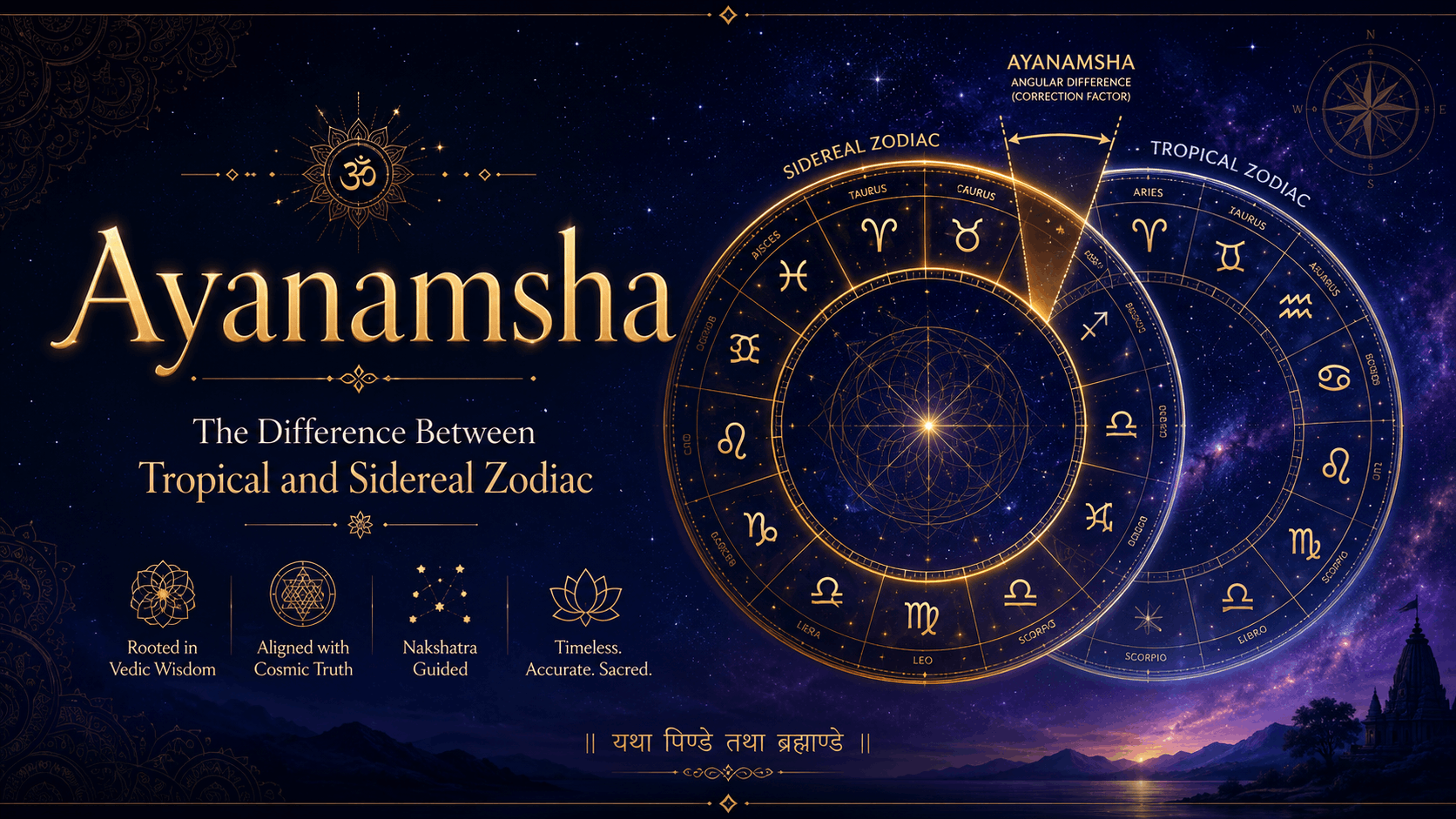
Ayanamsha is the angular difference between the Tropical zodiac, commonly used in Western astrology, and the Sidereal zodiac, widely used in Vedic astrology. It acts as a correction factor for the precession of the equinoxes.
The Earth’s axis slowly wobbles over time, causing the starting point of the zodiac to shift gradually. Because of this movement, the Tropical and Sidereal zodiacs drift apart by about 50.25 arcseconds per year.
In practical astrology, Ayanamsha is used to convert a planet’s Tropical longitude into its Sidereal longitude. This is done by subtracting the Ayanamsha value from the planet’s Tropical position.
Several Ayanamsha systems are used by astrologers:
Lahiri Ayanamsha
This is the most widely accepted Ayanamsha in India. It was officially adopted after the recommendations of the Government of India’s Calendar Reform Committee. It is commonly used in traditional Vedic astrology and Panchanga calculations.
Raman Ayanamsha
This system was promoted by the respected astrologer B. V. Raman. It is often followed by astrologers who use his methods and interpretations.
Krishnamurti or KP Ayanamsha
This Ayanamsha is used in Krishnamurti Paddhati astrology. KP astrology is especially known for its focus on precise event timing and prediction techniques.
In Vedic astrology, choosing the correct Ayanamsha is important because even a small difference can affect planetary degrees, divisional charts, Nakshatra placement, and prediction methods.